
To make friends as an adult man, start with the calendar
If you are trying to make friends as an adult man, do not begin by reinventing your personality. Begin by putting the same thing on the calendar twice. Adult life can mean losing the easy repetition that school and university supplied. A heroic night out can be excellent. It is still only one night.
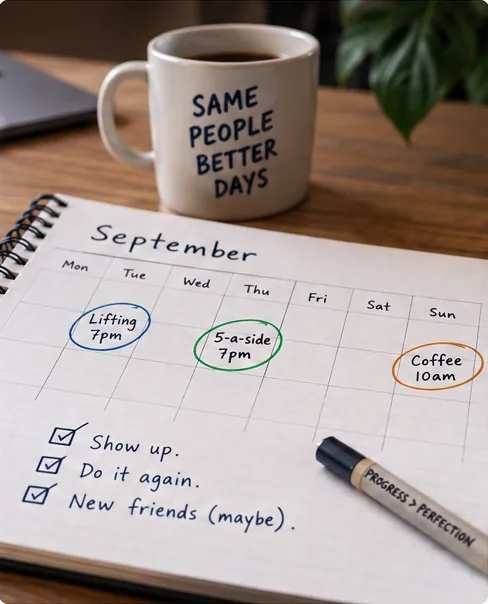
The useful shift is from event to fixture: Tuesday lifting, Thursday five-a-side, Sunday coffee after the dog walk. The activity is not a trick for avoiding conversation. It is simply a reason for both people to arrive before either has to deliver a TED Talk called Here Is Why You Should Like Me.
Friendship has an annoyingly large time budget
Communication researcher Jeffrey Hall surveyed 355 U.S. adults who had recently relocated and, in a separate longitudinal study, followed 112 first-year students at one Midwestern university. Both samples included men and women. Participants self-reported both hours and relationship categories. Hall’s synthesis - not three raw model cutoffs - suggested roughly 40 to 60 hours to form a casual friendship, about 80 to 100 to move from casual friend to friend, and 200 or more for friends to become good or best friends. The 40-to-60 and 200-plus summaries were framed around the first six weeks. These are observational estimates, not universal thresholds or a stopwatch.
Purely as arithmetic, 40 hours at ninety minutes a week is about 27 sessions. That sounds less terrifying when the session is something you wanted to do anyway. One good coffee can still be excellent; it just cannot establish whether a friendship will form. The group chat may develop advanced punctuation in the meantime.
Do something. Then commit the radical act of doing it again.
Hall found associations between time and closeness, but not all hours looked alike. In the relocated-adult study, hanging out and watching television, films or gaming were associated with greater closeness; a larger share of time at work or in class was associated with less closeness, while the shared-activity and group-activity measures were not significant. In the student study, a five-item bundle covering catching up, serious conversation, playful talk and affectionate talk was associated with increases in closeness at both follow-ups; more small talk was associated with a decrease only from weeks six to nine. None of that proves Tuesday football manufactures friendship. Our practical inference is smaller: a repeatable leisure plan can make room for the accumulated, chosen time the studies associated with closeness.
A separate qualitative study about men’s mental-health promotion used seven Sydney focus groups: 43 men plus 16 male stakeholders. Participants suggested sport, gardening, woodworking, car mechanics, mountain biking and similar interests as activities that could bring men together and give mental-health promotion a setting; they described expected enjoyment as a primary reason they might take part. The 43 community participants averaged 50.65 years of age; 72% had a university degree and 56% reported household income above $100,000. They volunteered through ads and community groups; stakeholders were purposefully recruited. The authors said the findings were not generalizable. Useful menu, then - not a universal map of male friendship.

Evidence Journal of Social and Personal Relationships · PLOS ONE
Your post-match brain is a suspicious witness
Across five studies, researchers found a ‘liking gap’: after conversations, people tended on average to underestimate how much the other person liked them and enjoyed their company. The samples included strangers in laboratories, attendees at several UK conversation workshops and first-year university dorm-mates; many participants were young or academically connected, and the finding was not specific to men.
So the internal review conducted on the journey home may be too harsh. That does not certify every promise of next Thursday; the studies measured perceived liking, not the reliability of plans. It does mean one awkward joke is weak evidence for cancelling week two. Ask clearly, take the answer at face value, and let the calendar - not mind-reading - supply the next data point.

Turn the evidence into a plan - not a promise
The studies do not establish a friendship recipe. The plan below is a practical way to make repeated, chosen time possible - not a guarantee of intimacy or perfect attendance. Missed one week? The fixture can still exist. Conversation was ordinary? Good. Ordinary is repeatable; fireworks are mainly useful for ending football matches and alarming dogs.
Choose something easy enough to organise, specific enough to happen and decent enough that you would go even before it becomes a friendship. Consistency gives the relationship opportunities; neither the calendar nor Brosky can promise the result. Your personality can stop performing unpaid overtime.
- Choose a recurring activity, not a vague promise to hang out.
- Name the day, time and place before everyone goes home.
- Invite one person into an open seat instead of broadcasting to a committee.
- Treat the next occurrence as the default, with room for an honest no.